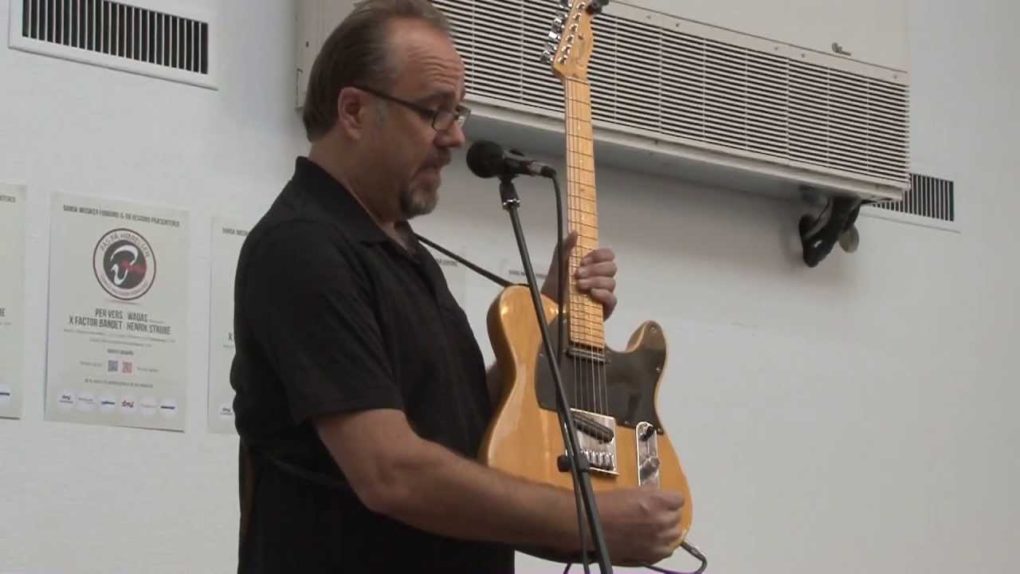
If you don’t know Greg Koch he’s a monster player, really tasteful, knowledgeable guitarist. He’s been a product demonstrator for Fender for years (I remember meeting him in Boston in 2001 ). This a great full clinic that hopefully will stay up on YT for a while. Please support this guitarist, it’s great to have his material on line, and I am sure there is something for everybody to learn from his playing.
I am not affiliated with him in any way, but this is his site: http://gregkoch.com/wordpress/
I am sure we are all a bit frustrated when it comes to tuning our guitars. As much as things have become easier by using a tuner of some sort, I always feel I have to always fine-tune my guitar as I start playing.
If you don’t want to go as far as installing the Buzz Feiten System, I suggest you watch the video below, where James Taylor shows you how to use a tuner with ‘cents’ to put the guitar very slightly out of tune to have a more pleasing experience along the fretboard and in different keys. You will be surprised!
What he suggests is this (in cents):
E= -3
B=-6
G=-4
D=-8
A=-10
E=-12
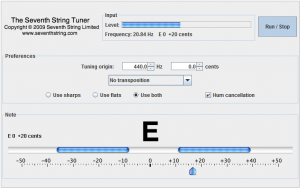
If you don’t have a tuner with cents you can use this great online java tuner from SeventhString:
http://www.seventhstring.com/tuner/tuner.html
You an also use a tuning app like GString for Android to monitor your tuning: when you feel that you are in perfect tuning at the end of a gig or session and keep track of what is the ratio/relation of cents between the strings. Write them down and see if there is a recurring pattern. I suggest you to do this when you are playing in a band setting, not just by yourself.
Just wanted to share this great video that explains in simple words the complex physics behind string vibration and how we perceive sounds and notes. Great stuff!
A couple of great videos by Wayne Krantz on how to practice with a metronome. You might like his style of playing or not, but you cannot deny that his time feel and ability to ‘lock in’ is phenomenal.
There are great metronome apps these days, so no excuses: you can have a metronome at your fingertips any time of the day for a quick practice session.
It’s better to practice 30 minutes a day than 10 hours once a week.
Take frequent breaks, distract your mind to then go back and give full attention to what you are doing. Usually 45 minutes practice followed by15 minutes break works for me.
Always warm up and stretch before playing for hours. Start slow with some technical exercises. I did a theatre gig for 3 years that had a 15 minute band call. I used that to warm up with different technical exercises, and I was shocked how just those 10 minutes every day gave a massive boost on my speed and articulation. 10 minutes!
I find that practising tunes (playing actual music) is better than spending hours practising technical exercises. Those are great to warm up. Composing new tunes, finding new ideas , learning and transposing tunes in all keys are by far the best things you can do when practising.
Try playing/practising in the dark (pitch black room or blindfolded). You will become more musical and less dependent on ‘visual patterns’. John Scofield used to do this all the time.
Keep a basic setup ready to go at all times (if you can at home), this is great for impromptu sessions, when you are more inspired to write/record/practice without loosing momentum by trying to find picks and cables.
Record your practice sessions and listen back after a few days to find what you can improve. If you practice with a computer or a phone, video your sessions and you’ll find also you can correct postural problems or see if your performance is visually boring!
Practising should not be a boring task. If you find it boring, don’t do it. You should be curious/excited about improving.
It is better to practice with a friend than along to backing tracks. Invest in a looper pedal (they can be super cheap these days), it can be fun and beats playing to a backing track. Playing along to tracks is not bad, but I find that after a while it’s easy to loose focus and just ‘noodle’. If you practice to tracks, take a short break after each one, don’t let one roll into the other.
Change your practice routine often. Just like working out at the gym, your body gets used to doing the same exercises and stops reacting. Rotate different exercises/tunes/tasks.