Author: Gianni C.

5 Mistakes of the rookie live musician/guitarist

When I am not playing gigs, I like to go to live music events of different genres and different levels…after a while, tired of seeing the same things done wrong over and over I thought of writing this short post.

So there you go: 5 mistakes a live musician should never make!

1. Noodling Before/Between Tunes

Very unprofessional, it will make you look like you have been playing for less than a week. It usually also gives away the tune that you are about to play which ruins the surprise effect on the audience. Bad Bad Bad! Even tuning nowadays can be done without making a sound (no excuse to be out of tune ever!).

2. Long gaps between tunes

Oh lord…seen too many times (what are we doing next?). It is ok for a last minute change, but this is the reason why there are setlists!! Each member should have one printed big enough to be read with very little light. Even a last minute show with people you never played with should be as close to a real show as it gets. No setlist? Think of what tune to play next while you are still playing!

3. Being Late

It’s not ‘fashionably late’. It’s just late. And it is not good. You don’t need to be there six hours before a gig, but I find that half hour preceding the start is vital to make sure everybody knows what’s going on, to make last minute changes or to make a good setlist if you are playing a last minute function, and to check that all your gear works.

4. Not bringing spares

You need and extra guitar, extra strings, basic tools to fix a last minute gear problem. Nowadays even a dead amp can be replaced with a small multi-fx with speaker simulator, plugged into a PA…regardelss if you like the tone or not, it will get you to the end of the gig.

5. Entertain

Because it is not fun to look at four guys staring at the floor for two hours, no matter how good you music is or great you are. Thank the crowd for coming to your gig, and the staff at the venue…they will remember.

The Impact of Guitar Picks on Tone and Playability

In the realm of music, every nuance matters, from the subtlest strum to the most intricate riff. Often, we lavish our attention and resources on pedals and other equipment, while overlooking one of the unsung heroes of our musical journey – the humble guitar pick. Recently, in a fascinating exploration, I delved into the world of guitar picks, realizing their profound influence on our tone and playability. Join me on this sonic adventure, as I tested 12 carefully selected picks to unravel their secrets.

The Quest for the Perfect Pick

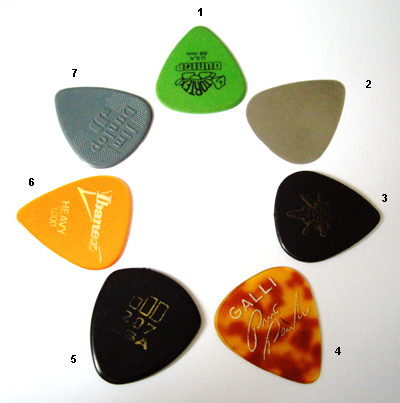
Having amassed a collection spanning three decades, I meticulously handpicked 12 contenders based on their size, material, and shape. My go-to pick, the D’Addario Delrin 88.8, served as the benchmark for comparison. The selection varied from the robust 1mm triangular Gin Dollop to the feather-light Galley pick, each promising a unique experience.

Unveiling the Picks

  • Dunlop 1mm: A thick, triangular pick resembling Santana’s choice, offering a robust, pointed sound.
  • Ibanez Heavy: Bordering on a bass pick, this heavyweight contender struck a balance between thickness and maneuverability.
  • Dunlop 207 Jazz Pick: Crafted for jazz enthusiasts, this pick boasted a round edge and substantial thickness.
  • ’90s Ibanez Picks: A relic from the past, these metal picks exuded a jagged, velvety attack, favored by the likes of Steve Vai.
  • Dunlop 96: A standard, heavier pick in the Dunlop series, striking a chord between versatility and durability.
  • Tortex 60: A slightly thinner version of the classic Tortex, perfect for those seeking a balance between flexibility and control.
  • Nylon Pick: A flexible, medium-thick pick with a distinct character, offering a unique tonal flavor.
  • Gibson Thin: Delicate as a whisper, this paper-thin pick explored the subtleties of sound, challenging traditional norms.
  • Fender Thin: With its intriguing pattern, this mixed-material pick combined artistry with finesse, perfect for nuanced strumming.
  • Galli Super Thin: As thin as a wisp of air, this pick defied conventions, allowing effortless bends and harmonics, albeit at the expense of durability.

Decoding the Sonic Symphony

The experiment involved a symphony of arpeggios, single notes, and simple chords, each pick composing a distinct melody. Thicker picks serenaded with pristine single notes, while their thinner counterparts danced gracefully across chords, creating a harmonious blend.

Your Turn to Tune In

As our sonic expedition concludes, I invite you to share your thoughts. What picks resonate with your soul? Are you drawn to the bold resonance of thicker picks or the delicate dance of their thinner counterparts? Have you stumbled upon a pick that feels like an extension of your musical identity?

(old video on picks)

These are the picks I have used during this lesson:

picks

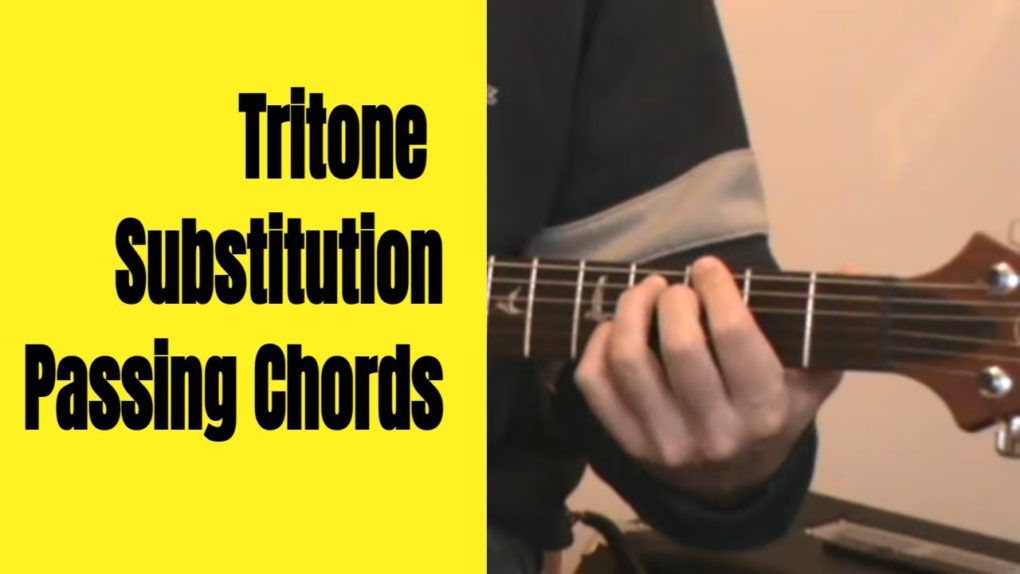
Tritone Substitution/Passing Chords

Very simple concept widely used in jazz ( but good for other styles). Like shown in the video, G7 and Db7 are two chords a tritone away (tritone=6 semitones) that share the same 3rd and 7th.

G7= G B D F

Db=Db F Ab B

as you see the notes B and F are common to the two chords. This means that I can also substitute the IIm chord that usually comes before it (as in a II-V-I)

I can play both

Dm7 G7 Cmaj7

Abm7 Db7 Cmaj7

Being a Freelance Guitar Player in NYC, 2010 by John Shannon

This is a guest post: by John Shannon. Modern guitarist, vocalist and song crafter John Shannon believes in the power of music to enlighten the mind. Having already toured the globe with some of the brightest rising stars of indie rock, folk and jazz including Sonya Kitchell, Haale and Hiromi, Shannon's solo work has taken him on a journey into his soul and beyond. More about him @ www.johnshannonmusic.com

Flexibility and Minimalism

There are two things that come to mind as far as the lifestyle requirements of a freelance guitarist in New York City: Flexibility and Minimalism. Lets take a look at what it means to be a flexible musician. First off, what it means to be musically flexible. This is not meant to feed the age old idea that you have to master all styles to be a great player, which is pretty much an unattainable ideal anyway. This is to suggest that you can jump into any musical style and bring something appropriate to the table as a guitarist. Most times I find people are hiring me not to blow them off the stage, but to play a part in the alchemy of their music. Iʼd like to note here that the highest goal as a sideman should always be to make everyone around you sound great, always be a servant to the music and the musicians around you. To be flexible means to be able to play a few jazz standards, to pull out a Beatles song or two off the top of your head, to fake Jimmy Pageʼs solo on “Stairway to Heaven”, to know all current bands in case someone sais “can you make it sound more like Kings of Leon”, to play quiet, to play loud, to have a range of guitar effects that cover most scenarios, to know when to lay out and stop playing, to have a few classical pieces under your belt, to be able to conjure a decent intro to any given tune, and most of all to listen. You have to become a great listener. Not only constantly listening to new and old music, but to know that when someone sais they want something musically, to know what they really mean though they donʼt know how to express it in guitar terms. Such as “can you play it more like thereʼs a tumbleweed rolling by…” To which you either walk out the door (just kidding) or switch to your bridge pickup, put on a little tremolo and twang out a straight open D minor chord.
The other flexibility Iʼm talking about is with your schedule. You have to make things work as much as possible for the people who are hiring you so that itʼs easy for them and so theyʼll want to have you back on their gig. You have to be up for a rehearsal or two with or without pay to begin a new music relation. You have to be up for a hang at all times to keep meeting new people to play music with. Saying all this may make it all seem like a big old hustle, but if youʼre playing music because you love music then itʼs a joy to constantly meet new people who also love to play music. This is also not to say that you shouldnʼt turn gigs down. For the most part as a freelancer you should take all gigs that come your way, but if you really donʼt like a project, do yourself and the artist a favor and donʼt take it. If weʼre gonna play music for a living we should enjoy it. With that being said, part of flexibility is knowing how to enjoy all music. Get to know your limits on all fronts so that you donʼt burn out because free lancing anything in New York City is a very active lifestyle.
Next, a key factor, I think, in being a free lance guitarist in New York City is adopting the minimalist mindset. Hereʼs why: If you play guitar with the minimalistʼs mindset combined with aware listening, you will never get in the way on someoneʼs gig. That is the first unspoken rule for any artist when they are considering whether or not to continue working with you. It is much better for someone to ask you to turn up then to turn down. Be aware of the space you occupy in any given situation, and start small. Minimalism in music relates to appropriateness in music. Also in naming minimalism as a key factor in NYC freelancing, I mean that your lifestyle may require it. I donʼt really need to say this, but if your motivation for playing music as a guitarist is to get rich, you are better off practicing Guitar Hero until they enter it into the Olympics. Iʼm not saying it wonʼt or canʼt happen, Iʼm just saying it takes alot of standard $50 gigs to buy a penthouse apartment. For that matter the same goes for anyone who is in music to make money before making music: better to become a doctor instead and help people while earning alot of money because creating intentionless music governed by the latest music fad to dominate the radio, internet, and tv waves only serves to make society less intelligent as a whole. Stepping off my soap box now, you also need to figure out how to achieve a great sound with a minimal amount of gear. New York has an extensive subway system and you donʼt want to have to worry about finding a parking spot right before the gig. For me a small light solid state amp on a cart (bumpy sidewalks can ruin small tube amps), a small shoulder strap pedal board and a gig bag guitar case work just fine. You also want to spend time learning the range of your effects so you can make the most of just a few pedals.
You have to be willing to live minimally and enjoy it. Learn how to make the money you earn spread. Minimalism will take care of that. Itʼs important for me to say that you donʼt have to be a “starving artist”. With this mindset you can be a “surviving minimalist”, doing what you love.
In conclusion, the main thing is to learn how to let the music guide your life. If you love to play guitar, then make it your spiritual path and learn how to listen to it for guidance. Donʼt respond to vibrations of urgency or negativity from anyone. Stay in the zone and believe in your own guitar playing. The rest will take care of itself.

-js


http://www.johnshannonmusic.com

http://www.myspace.com/johnshannonmusic


The Advancing Guitarist – by Mick Goodrich – Review

I am going to start this section of books reviews with possibly one of my favorite guitar books. The Advancing Guitarist by Mick Goodrich. This is a book that you can pick up at any level, and learn something. Mick’s approach is very mathematical and often in this book goes through any possible combination of elements (notes, fingerings…) for you to fully explore your instrument and your music knowledge.

The book goes  through many different topics, from technique to advanced harmonic concepts (quartal harmony, use of superimposed triads and so on), Rhythmic concepts and also spends quite some time on self criticism. This last thing in my opinion is the strength of this book: it makes you think, and it makes you make the conscious effort of improve on every level. This is not a book that you’ll go through once, and forget about. I personally pull this book out every so often and still find things that I put straight into my playing. Highly recommended if you are serious about your playing.

This is a preview of the book:

http://www.amazon.co.uk/gp/reader/0881885894/ref=sib_dp_pt#reader-link