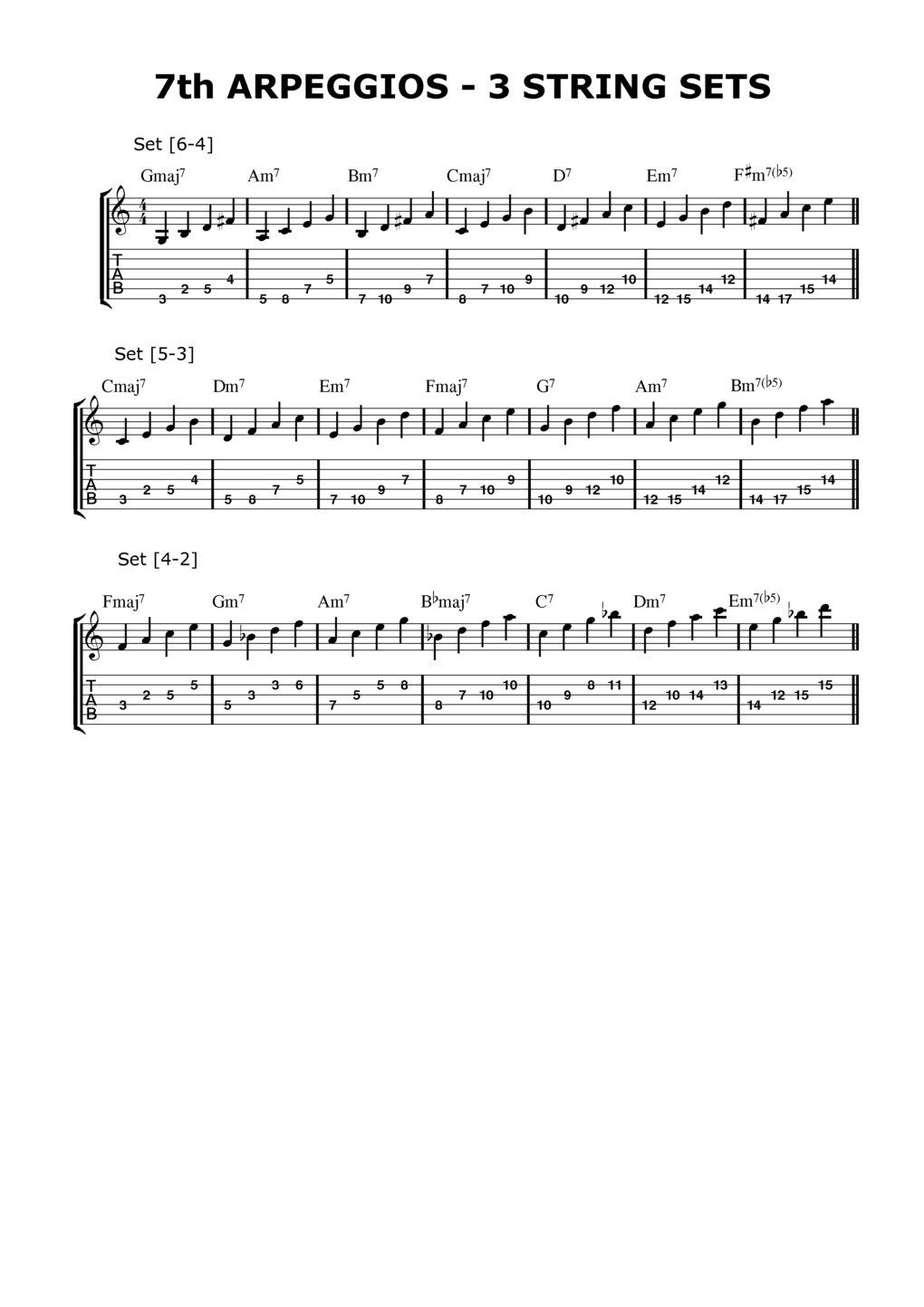
Are you tired of struggling with guitar arpeggios? A few weeks ago, we explored how to play seventh chords all over the fretboard. Today, let’s delve into connecting chords, scales, modes, and arpeggios seamlessly on your guitar.
1. Understanding the Connections
When it comes to understanding chords, scales, modes, and arpeggios, it’s crucial to visualize and hear them as interconnected elements. For instance, visualizing a C major chord leads to understanding its corresponding scale, arpeggio, and potential phrases that can be played over it. These elements should not be learned in isolation; they should be viewed and heard as part of a unified whole.
2. Exploring Different String Sets
We explore arpeggios across three main sets of strings: the low set (root on E string), the middle set (root on A string), and the top set (root on D string). Understanding these sets provides a versatile foundation for navigating arpeggios in various positions on the guitar.
3. Common Fingerings for Seventh Chords
Certain seventh chords share common fingerings or shapes. For example, G major 7 and C major 7 on the same set share the same fingering. Recognizing these patterns simplifies the learning process and facilitates smooth transitions between chords.
4. Practical Application in Jazz Standards
To apply these arpeggios, consider a standard jazz tune. By identifying chord roots and playing arpeggios corresponding to the chords in the progression, you create a strong framework. These chord tones can serve as a foundation for improvisation, allowing you to navigate the tune with confidence and creativity.